 Practical AtlasIndependent reference
 ESP
ESP KOR
KOR JPN
JPN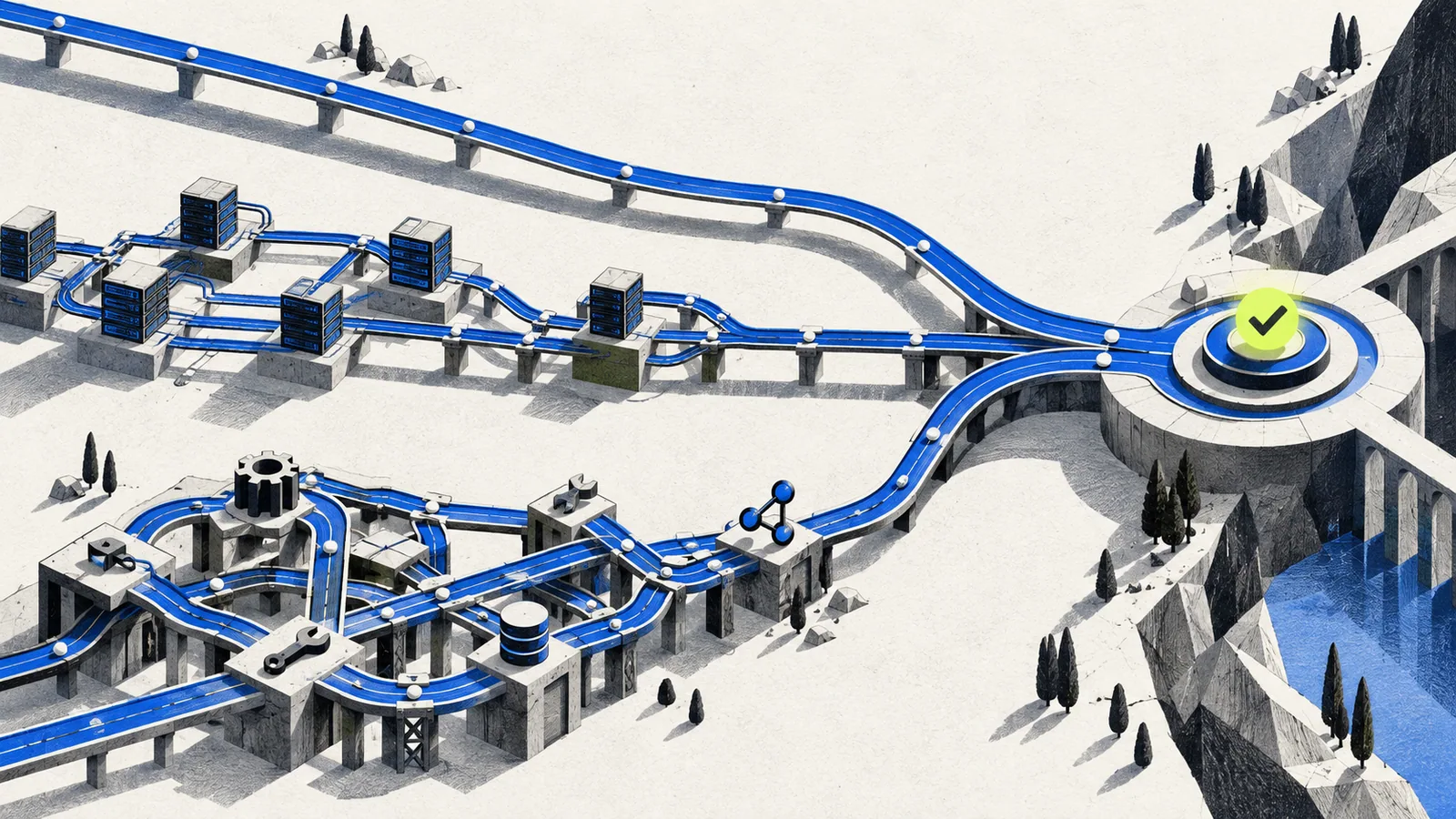
Choose the system around the task
A coding agent is more than a model. Its result depends on repository context, instructions, tools, permissions, environment, tests, and review. Begin with the smallest representative task and an acceptance set. Then compare candidate models inside the same harness. A model that wins a public coding benchmark can still lose in your repository because it misses local conventions, waits poorly for tools, or spends too much to reach an accepted patch.
Classify the task before selecting the model
Separate work by consequence and coordination load. A typo fix, structured extraction, single-file feature, cross-repository migration, and browser-plus-code workflow should not share one default tier. Record the number of files likely to change, context needed, tools required, external side effects, and cost of a failed attempt.
- Routine: constrained transformation with a deterministic schema or test.
- Repository: several related files with local conventions and regression risk.
- Agentic: long-running work across code, browser, terminal, or documents.
- High consequence: security, finance, production data, or irreversible external action requiring specialist review.
Use a scorecard that can reject a model
Measure task completion, not eloquence. A useful coding scorecard includes acceptance-test pass rate, unnecessary diff size, instruction violations, tool-call recovery, time to first valid result, total tokens, number of retries, and reviewer minutes. “Almost correct” should not receive the same score as a patch ready to merge. If a task needs human repair, include that time and risk in the cost.
Route routine work cheaply and escalate on evidence
OpenAI’s current catalog separates a highest-capability model from balanced and cost-sensitive alternatives. That is a routing hint, not proof for your codebase. Start routine work with the least expensive candidate that reliably passes the acceptance set. Escalate when failure points to reasoning depth, long-range dependency tracking, or tool coordination—not merely because the first answer was stylistically weak.
A simple policy might send file classification and boilerplate transformations to a low-cost tier, ordinary bounded features to a balanced tier, and difficult migrations or recovery from failed attempts to the highest-capability tier. Re-evaluate the thresholds monthly because models, prices, and tooling change.
Run a small paired pilot
Select ten to thirty anonymized tasks that resemble real work and include at least a few failures from the current process. Give every candidate the same starting state, tools, time limit, and instructions. Blind the reviewer to the model name when practical. Repeat nondeterministic tasks enough times to expose variance. Keep the winning patch only after the normal test and review process.
Verify before continuing
Does the test set resemble work you will actually send? Are all candidates using the same tools and context? Are reviewer time and retries counted in cost? Can a cheap tier escalate without hiding its failed attempt? Are high-consequence actions still gated outside the model?
- Does the test set resemble work you will actually send?
- Are all candidates using the same tools and context?
- Are reviewer time and retries counted in cost?
- Can a cheap tier escalate without hiding its failed attempt?
- Are high-consequence actions still gated outside the model?
QUESTIONS THIS ANSWERS
Questions this answers
- How do I choose an AI model for a coding agent?
- Should every coding task use the most capable AI model?
Found something wrong? Report an error or read the corrections policy.
3 SOURCESEvidence ledger
Sources
- 01Models and model selection ↗
OpenAI · accessed 9 Sept 2026
- 02Compare models ↗
OpenAI · accessed 9 Sept 2026
- 03GPT-6 Astra model guidance ↗
OpenAI · accessed 9 Sept 2026